
According to the American Veterinary Dental Society, 70% of adult cats and 80% of adult dogs show symptoms of oral disease. Don’t let your pet become part of this statistic! Proper dental care can keep your pet happy and healthy.
A Dental Cleaning Is More Than Removing Tartar
Dental disease isn’t just about bad breath or dirty teeth. Much of the disease we find in pets is hidden below the gumline, where it can’t be seen during an awake exam.
Our goal isn’t simply to make your pet’s teeth look cleaner. We want to evaluate their entire mouth, identify painful or diseased teeth, treat problems when needed and help protect their long-term oral health.
What Happens During Your Pet’s Dental Procedure?
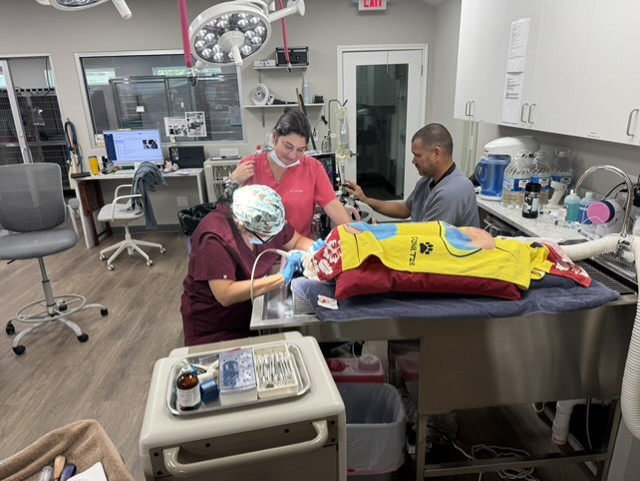
Pre-Anesthetic Evaluation — Before anesthesia, we evaluate your pet and recommend appropriate pre-anesthetic testing based on their age, health and medical history. This helps us create an anesthetic plan specifically for your pet.
IV Catheter & Individualized Anesthesia — An IV catheter provides access for fluids and medications throughout the procedure. Anesthetic medications and protocols are selected based on the individual patient.
Continuous Anesthesia Monitoring — Your pet is continuously monitored by a trained team member. We monitor blood pressure, ECG, oxygen saturation, end-tidal CO₂, temperature, respiratory rate and anesthetic depth.
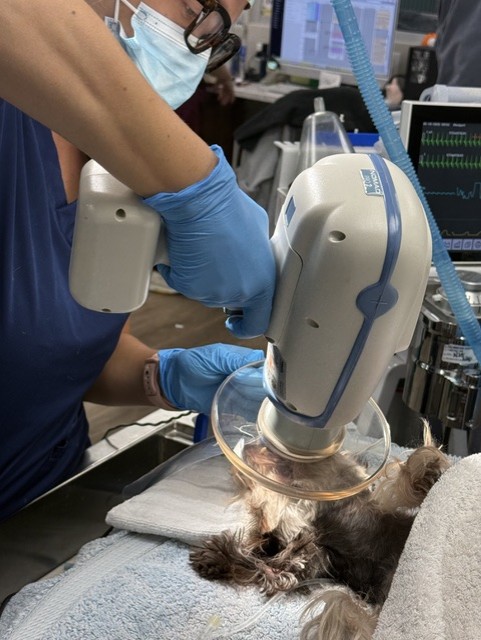
Full-Mouth Dental Radiographs — Every Patient, Every Dental — We take full-mouth dental radiographs on every dental patient. A large portion of each tooth lies below the gumline where we simply cannot see it during an oral exam. X-rays allow our doctors to evaluate every tooth from crown to root as well as the surrounding bone.
We don’t wait until a tooth looks abnormal to take an X-ray. Teeth that look normal above the gumline can have significant and sometimes painful disease underneath it.
Complete Oral Examination — Once safely anesthetized, the veterinarian can thoroughly examine the mouth and evaluate each tooth.
Scaling Above AND Below the Gumline — We remove plaque and tartar from the visible tooth surface as well as below the gumline, where periodontal disease develops.
Polishing — After scaling, the teeth are polished to smooth microscopic scratches on the tooth surface and help reduce future plaque accumulation.
Treatment When Needed — If we identify painful, damaged or significantly diseased teeth, the veterinarian may recommend treatment or extraction. When possible, we discuss anticipated treatment and costs beforehand.
Pain Management — When extractions or other painful procedures are necessary, we use appropriate pain medications and local anesthetic techniques based on the patient’s needs.
Monitored Recovery — Care doesn’t stop when the dental procedure is finished. Your pet continues to be monitored during recovery with attention to comfort, temperature and pain control.
Why Do We Take Full-Mouth Dental X-Rays on Every Patient?
Because what we can see above the gumline is only part of the story.
Dental X-rays can reveal tooth-root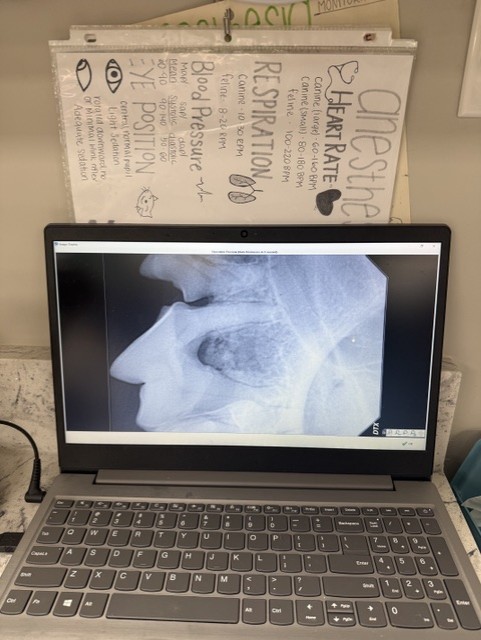 infections, bone loss, fractured or abnormal roots, retained roots, resorptive lesions, impacted or unerupted teeth and other painful disease hidden below the gumline.IMG_0886.jpeg
If we don’t look below the gumline, we’re only seeing part of the tooth.
What You See
Plaque, tartar and the visible portion of the tooth.
What We See With Dental X-Rays
The roots, surrounding bone and disease that may be completely hidden below the gumline.
Our Goal Is a Healthier, More Comfortable Mouth
Our goal is not simply cleaner-looking teeth. It’s identifying and treating dental disease, controlling pain and helping your pet leave with a healthier, more comfortable mouth.
Some of the signs that indicate your pet may be experiencing a dental problem include:
- Bad breath
- Loose, broken or missing teeth
- Yellow or brown teeth
- Red, inflamed or bleeding gums
- Difficulty or pain when chewing
- Pawing at the mouth
- Excessive drooling
If you notice any of these signs or symptoms, even if you regularly bring your pet in for dental care, give us a call. The sooner we address a potential problem, the better the chances of a positive outcome.